Skin Health
Non-Surgical Lower Face Lift in Bangkok: What It Actually Fixes (and What It Doesn’t)
“My jawline used to be sharper” is one of the most common things we hear in consultations — and it’s rarely about weight. Here’s what’s actually happening to the lower face after 30, and which non-surgical options genuinely help.

Why the Lower Face Changes First
Most people notice aging in their lower face before anywhere else — a jawline that’s lost definition, jowls forming along the chin-to-neck line, or a lower face that looks “heavier” even at a stable weight. This isn’t random. The lower face is structurally the first to show laxity because it depends on deeper connective tissue support (the SMAS layer) that thins with age, combined with gravity acting on skin that has less elastin to resist it.
It’s rarely about fat gain. It’s about structural support loosening beneath the skin — which is why surface-level skincare and weight loss often don’t fix it, and can sometimes make the hollowing look more pronounced.
What “Non-Surgical Lower Face Lift” Actually Means
A non-surgical lower face lift refers to a category of treatments that lift and tighten the lower third of the face — jawline, jowls, chin-to-neck transition — without incisions, anesthesia, or downtime. Instead of surgically repositioning skin and muscle, these treatments work by stimulating the skin’s own collagen-building response at the deeper SMAS layer, the same structural layer addressed in a surgical facelift.
At Matrix Clinic, this is built around Ultraformer III, a HIFU (High-Intensity Focused Ultrasound) device that delivers focused energy to precise depths beneath the skin — tightening existing tissue while triggering new collagen production over the following weeks and months.
Who It’s Actually For
Non-surgical lifting works best for mild to moderate laxity — early jowling, a jawline that’s softened but not collapsed, a slightly heavier lower face. It’s a strong fit if:
• You’re noticing changes but aren’t ready for (or don’t need) surgery
• You want to stay ahead of visible aging rather than correct it after the fact
• You have zero tolerance for downtime
It’s not a substitute for surgery in cases of significant skin excess or advanced laxity — and a good clinic should tell you that honestly in consultation, rather than oversell a device as a surgery replacement.
What to Expect: Timeline and Results
Results build gradually rather than appearing immediately, because the treatment works by stimulating your own collagen over time:
• First few weeks: subtle tightening as existing collagen fibers contract
• 1–2 months: visible improvement in jawline definition as new collagen forms
• Full results: typically settle in around the two-to-three month mark
• Duration: results commonly last several months to a year, depending on skin condition, age, and lifestyle factors like sun exposure and sleep
A single session is standard for most people with mild-to-moderate concerns; more pronounced laxity may benefit from a follow-up session.
Non-Surgical vs. Surgical: An Honest Comparison
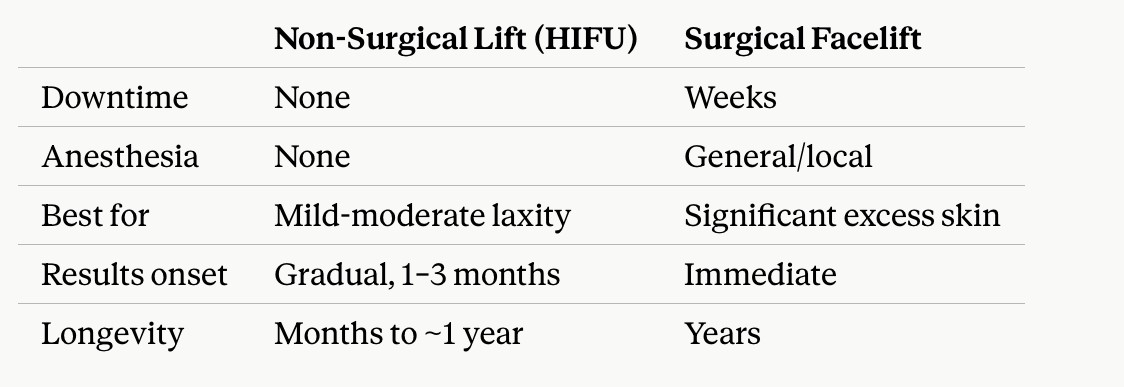
Neither option is universally “better” — the right choice depends on how much structural change is actually present, which is why an honest assessment matters more than the treatment name.
Frequently Asked Questions
Does a non-surgical face lift hurt?
Most people describe it as brief warmth or tingling during treatment, not pain. No anesthesia is required for standard protocols.
How soon will I see results?
Initial tightening can be felt right after treatment, but visible jawline definition typically builds over 4–8 weeks as new collagen forms.
Is one session enough?
For mild-to-moderate laxity, often yes. More pronounced sagging may be recommended a second session for optimal results — this is assessed individually, not sold as a package by default.
How is this different from fillers?
Fillers add volume; a HIFU lift tightens and lifts existing tissue. Many patients benefit most from a combination approach, assessed case by case.
The Real Question to Ask Before Booking
The most useful question isn’t “which device is best” — it’s “does my lower face actually need structural lifting, or is this a volume or skin-quality issue instead?” That distinction changes the entire treatment plan, and it’s the first thing we assess in every consultation at Matrix Clinic before recommending anything.
This article is for general educational purposes and does not constitute medical advice. Individual treatment plans should always be discussed with a qualified physician.
Read tips, insights, and stories.


